 Hin
Hin En
En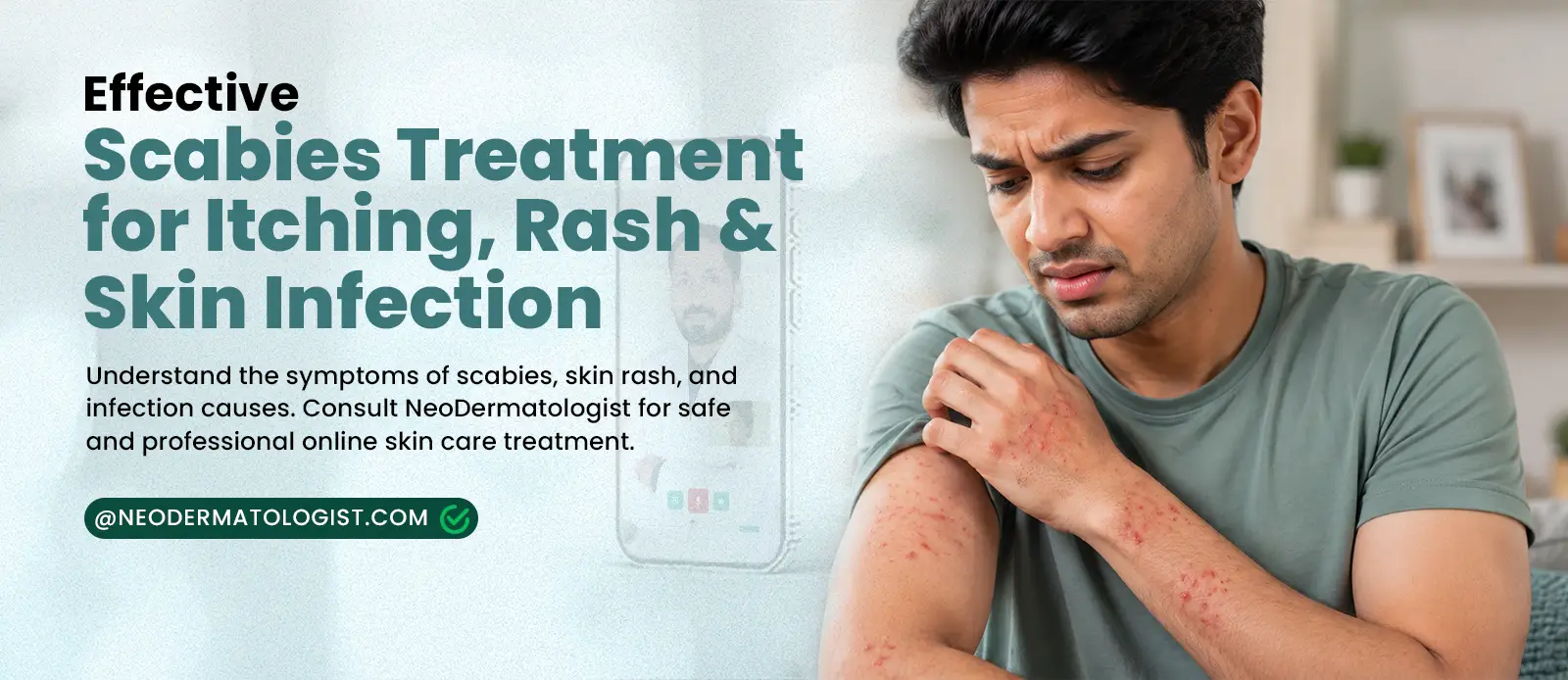


Scabies Rash: Causes, Early Symptoms, Types & Dermatologist Treatment
Introduction
Medically Reviewed by Dermatologist - Dr. Ruchir Shah (MD Dermatology)
⭐⭐⭐⭐⭐ 25,000+ Online Dermatology Consultations Completed | Trusted Skin Care by Experienced Dermatologists
This article is medically reviewed to ensure accurate, evidence-based information about the causes, signs, symptoms, types and treatment of scabies rash.
Hi, I’m Dr. Ruchir Shah, a consultant dermatologist with over a decade of experience treating skin conditions like scabies across India. Every week, patients come to me with the same worry: intense itching that’s worse at night, small bumps between the fingers, and a rash that’s slowly spreading to family members.
If that sounds familiar, you are not alone - and this blog is exactly what you need to read right now.
Scabies is one of the most common and most misdiagnosed skin infections in India. In this guide, I’ll walk you through what causes scabies, how to recognize the early symptoms before they spread, the different types of scabies, and the most effective dermatologist-recommended treatment options available today.
Looking for safe, effective online treatment for scabies from the comfort of your home? You can consult our dermatology team directly through NeoDermatologist.com.
What Causes Scabies?
Scabies is caused by a microscopic mite called Sarcoptes scabiei. These mites burrow into the outer layers of human skin where they lay eggs, triggering an intense immune reaction that causes itching and rash.
Scabies, also known as khas in Hindi, is caused by a mite called Sarcoptes scabiei. Scabies (khas) is a contagious disease. These mites burrow under the skin, triggering itching and rashes.
How does scabies spread?
- Direct, prolonged skin-to-skin contact with an infected person (most common route)
- Sharing clothes, towels, or bed sheets with someone who has scabies
- Living or sleeping in the same space as an infected family member
- In crowded settings such as hostels, childcare centres, or factory dormitories
Key fact: The scabies mite can survive for 24–36 hours at room temperature and can spread infection through the skin. It is more common in crowded places such as hostels and among factory co-workers. Scabies can cause itching all over the body, which usually increases at night. The scabies mite burrows into the skin, creating tunnel-like structures that are serpentine in shape and about 5 mm long.
Scabies usually affects body areas with less hair, such as:
- Web spaces between fingers
- Wrists and inner elbows
- Navel and waistline
- Underarms and inner body folds
- Buttocks and genital area
- In children and infants: scalp, palms, and soles of feet
Did you know? Scabies burrows appear as thin, wavy or serpentine lines about 5 mm long on the skin surface. These are the tunnels made by the female mite. Finding a burrow is the clearest diagnostic sign of scabies.
If you’re experiencing intense itching or rashes that worsen at night, early diagnosis is crucial to prevent the spread of scabies. Consult a top dermatologist at NeoDermatologist through an online dermatology consultation to get expert evaluation, proper treatment, and guidance from the comfort of your home.
Note: Scabies can sometimes look similar to urticaria (hives), as both may cause intense itching, especially at night. To understand the key differences in symptoms and causes, read our Urticarial Rash Causes blog and learn how urticaria differs from scabies.
Scabies Symptoms in Humans
The symptoms of scabies can take 2-6 weeks to appear after the first exposure (because your immune system needs time to react to mite proteins). However, if you have had scabies before, symptoms can appear within 1-4 days of re-infection.
The most common scabies symptoms in humans include:
- Severe, persistent itching that gets significantly worse at night
- Red bumps, small blisters, or a pimple-like rash on the skin
- Thin burrow-like tracks or lines on the skin (about 5 mm in length)
- Sores or skin thickening from repeated scratching
- Itching that may spread even to body parts where no rash is visible (immune reaction)
Scabies Symptoms in Early Stages
Recognizing scabies early is the single most important step to prevent it from spreading to your family. Here is what early-stage scabies typically looks and feels like:
In the early stages of scabies, symptoms may appear mild and often go unnoticed:
- Mild but persistent itching between fingers, around the wrists, or inside elbows - especially when in bed at night
- Small red bumps or papules that may be mistaken for insect bites or heat rash
- Faint, scratch-like marks on the skin between fingers
- Irritation that appears to 'move' or spread over days
Important: Early-stage scabies is mild and easy to treat. If ignored, it spreads within 4–6 weeks to other family members who share the same bed or towels. Treat at the first sign.
Types Of Scabies
This is the most common form, affecting otherwise healthy adults and children. It causes the typical itchy red rash, burrow lines, and worsening itch at night. Body areas with less hair (wrists, web spaces, navel, underarms) are most affected. Mild to moderate severity. Responds well to topical treatment.
1. Classic Scabies
- The most common form of scabies, seen in otherwise healthy individuals.
- Caused by the scabies mite burrowing under the skin, leading to itching, redness, and thin burrow-like lines.
- Usually affects areas with less hair such as the wrists, elbows, between fingers, underarms, waistline, and around the navel.
- If untreated, these symptoms can spread quickly and may be confused with other skin conditions.
2. Crusted Scabies (Norwegian Scabies)
- A severe and highly contagious form of scabies. Characterized by thick crusts of skin containing thousands of mites and eggs.
- Mostly seen in people with weak immune systems such as the elderly, HIV patients, or those on long-term medications that suppress immunity.
- Unlike classic scabies, this type may not always cause severe itching but poses a higher risk of spreading to others.
Why this matters for families: One untreated person with crusted scabies can infect an entire family. Unlike classic scabies, the itch may be mild or absent, making it easy to miss. If a family member with low immunity has flaky or crusty skin, please consult a dermatologist immediately.
3. Nodular Scabies
- A less common type of scabies, often seen in children and infants.
- Appear as hard, itchy nodules (red-brown lumps), particularly around the genital area, underarms, and groin.
- These nodules may persist even after scabies treatment because of the body’s immune response to mite proteins.
- Requires special attention from a dermatologist, as itching can be intense and lead to secondary infections from scratching.
Each type of scabies requires a proper diagnosis and treatment plan. Early identification - especially of crusted or nodular scabies - is crucial to prevent spreading within families or communities.
To gain a better understanding, I have included a table below that highlights the different types of scabies, their symptoms, severity, and the individuals most at risk.
Consult a dermatologist online, who may recommend a short course of topical steroids to resolve the nodules.
Comparison of Different Types of Scabies
Types Of Scabies | Key Symptoms | Severity | Who Is At Risk? |
| Classic Scabies | Itchy red rashes, thin burrow-like lines, irritation worse at night | Mild to Moderate | Anyone; commonly spread in families, schools, and crowded places. Itch Level - Intense |
Crusted (Norwegian) Scabies | Thick crusts of skin with thousands of mites, scaling, may have little or no itching | Severe & Highly Contagious | People with weak immune systems (elderly, HIV patients, long-term steroid users) Itch Level - Mild or absent |
Nodular Scabies | Hard, itchy red-brown nodules, especially around the genitals, underarms, and groin | Moderate | More common in children and infants; it can persist after treatment Itch Level - Intense |

Scabies Disease Treatment
In scabies treatment, a combination of topical scabicides, corticosteroids, oral antihistamines, and skin-friendly soaps is commonly recommended by the skin specialist or dermatologist.
Scabies is completely curable. With the right treatment applied correctly, most patients see significant improvement within 2-4 weeks. The key word here is ‘correctly’ - treatment failure in scabies is almost always due to incorrect application or treating only one family member.
Below, we share all details of the cream for the treatment of Scabies - Discover effective relief from itching and infection with a complete guide covering all cream details, tablets, proper usage, and when to consult a dermatologist online.
1. Common Topical Scabicides (Creams & Lotions):
These are applied directly to the skin and are the first line of treatment for scabies.
| Medicine | Formulation | Notes |
| Permethrin 5% cream | Cream | Most preferred - safest, lowest resistance, approved for infants 2+ months |
| Benzyl Benzoate | 12.5% / 25% lotion | Effective, but more irritating; apply 2-3 nights in a row |
| Lindane 1% | Cream or Lotion | Not recommended for children, pregnant/nursing women or those with seizures |
| Crotamiton 10% | Cream | Mild option; also relieves itch |
| Ivermectin 1% | Lotion | Topical option; newer formulation |
Note: Permethrin remains the most widely used because it is safer and more effective compared to others.
2. Dosage of Permethrin 5% Cream (Single Application):
- Adults: 30 gm tube
- Children (6–12 years): 15 gm (half tube)
- Children (1–5 years): 7.5 gm
- Infants (<1 year): 3.75 gm
If the cream is not applied in an adequate quantity, treatment failure may occur.
3. Relief from Itching:
- Oral antihistamines such as Levocetirizine and Desloratadine are used to reduce itching and improve comfort.
How to Apply Permethrin 5% Cream – Step by Step
1. Preparation
- Take a bath or wash your body with mild soap and lukewarm water.
- Dry the skin completely before application.
2. Application
- Apply the cream evenly over the entire body from the neck downwards.
- In infants and young children, also be applied on the scalp, face (avoiding eyes and mouth), ears, and neck, since scabies often affects these areas.
- Pay special attention to skin folds (between fingers, underarms, groin, buttocks, soles of feet).
3. Amount to Use
- Adults: full 30 gm tube (one-time use)
- Children (6–12 years): about 15 gm
- Children (1–5 years): about 7.5 gm
- Infants (<1 year): about 3.75 gm
4. Duration
- Leave the cream on the skin for 8–14 hours (overnight is preferred).
- After this period, wash it off with mild soap and water.
5. Clothing & Bedding
- Wear clean clothes after application.
- Wash all clothes, towels, and bed linens in hot water and dry in sunlight or a hot dryer to prevent re-infestation.
6. Reapplication
- In most cases, a single application is effective.
- If symptoms persist or new burrows appear, a second application after 7 days may be required.
7. Precautions
- Avoid contact with eyes, nose, and mouth.
- Do not use more than the recommended amount.
- Consult a doctor before use in pregnant or breastfeeding women.
4. Oral Treatment for Scabies
In cases of crusted scabies, widespread infestation, or when topical treatment has failed, oral ivermectin is prescribed. This is especially useful for patients who have difficulty applying cream across the full body (elderly, those with physical disabilities).
- Oral Ivermectin is typically prescribed as a single dose (200 mcg/kg body weight), repeated after 7–14 days.
- It is NOT approved for children under 15 kg or pregnant/breastfeeding women.
- Oral treatment is always combined with topical scabicide for best results.
- Antihistamines (Levocetirizine or Desloratadine) are given alongside to control itching while treatment takes effect.
Do not self-medicate: Oral ivermectin is a prescription medicine and must be taken under medical supervision. Book a consultation with our dermatologists online for a proper prescription.
Why Scabies Treatment Fails - And How to Avoid It
| Reason for Failure | What To Do Instead |
| Cream is applied only to itchy spots | Apply head to toe (neck down). Scabies mites can be anywhere, not just where it itches. |
| Hands are washed after applying cream | Do NOT wash hands for at least 8 hours. Hands are a primary infection site. |
| Not enough cream used | Use the correct dose for your age/weight. Insufficient quantity = incomplete kill. |
| Other family members not treated | Treat ALL family members on the same night, even those with no symptoms. |
| Bedding/clothes not washed | Hot wash all fabrics the same day. Mites on bedding can cause re-infestation within 24–48 hours. |
| Post-treatment itch misread as failure | Itching can persist for 2–4 weeks after successful treatment (it is an immune reaction). It does NOT mean the mites are still alive. |
Scabies Contact Precautions
- Avoid skin-to-skin contact with the infected person until both parties have completed treatment.
- Do not share towels, clothes, or bed linen with the infected person during treatment.
- Wash all shared fabrics on the same day treatment begins (hot water, hot dryer or direct sunlight).
- For items that cannot be washed (stuffed toys, pillows), seal them in a plastic bag for at least 72 hours to kill any mites.
- All close household contacts should be treated at the same time, even if they show no symptoms yet.
- In institutional settings (schools, hostels, care homes), inform the institution's health staff so that a coordinated treatment of all contacts can be arranged.
Still Have Questions or Need Personalized Help?
If you’re struggling with persistent or recurring scabies, don’t wait. Get an accurate diagnosis and a complete scabies treatment plan from our dermatologists online.
For faster support, connect with our AI Dermatology Chatbot - can take your case history and instantly book an online consultation. You can even consult a dermatologist instantly on WhatsApp.
Our expert dermatologists, Dr. Ruchir Shah and Dr. Karma Patel, are here to provide safe, effective, and personalized care for scabies and other skin conditions.
Things Patients Should Keep In Mind During Treatment
- You must apply the medicine at night before sleeping.
- Apply the medicine on clean and dry skin.
- Apply it on the entire body below the neck. If the patient is less than 2 years old, then the medicine should also be applied on the scalp and face.
- Do not wash your hands after applying the medicine.
- After applying the medicine, make sure your hands do not touch other parts of the body such as eyes, nose, and mouth.
- If any other family member is experiencing itching, they must also be treated.
- The medicine should be applied only as directed by the doctor, and it should not be reused without the doctor’s advice.
When to See a Dermatologist
Most scabies infections respond well to treatment at home with a prescription. However, consult a dermatologist immediately if:
- Itching continues for more than 4 weeks after completing treatment (could indicate re-infestation or treatment failure).
- The rash is spreading rapidly or forming crusts (possible crusted scabies).
- A child under 2 years or an elderly family member develops intense, unexplained itch.
- Sores from scratching appear infected (swollen, warm, oozing, or very painful).
- Multiple family members are developing symptoms despite treatment.
At NeoDermatologist.com, you can consult Dr. Ruchir Shah or Dr. Karma Patel online from the comfort of your home. No travel, no waiting room. Our dermatologists provide a personalized treatment plan, prescriptions, and follow-up support for scabies and other skin conditions.
Resources and Videos
Want to learn step-by-step how scabies is treated? Watch our detailed scabies treatment video to know how to consult a Neodermatologist for specialized online consultations.
If you are looking for a Free Online Dermatologist Consultation
Click on the link to book a free dermatologist online consultation for scabies with our dermatologists.
At NeoDermatologist, we don’t just help with scabies - our team provides specialized solutions for a wide range of skin and hair problem services. You can also explore:
- Online Hair Loss Treatment
- Acne Treatment Online
- General Skin Consultation
- Inner Part Itching Treatment
- Melasma Treatment Online
- Vitiligo Disease Treatment Online
We also provide targeted care for conditions like Online Eczema Treatment, Scabies, Skin Care Consultation Online, Psoriasis, Urticarial Hives Rash, Vitiligo, and Ringworm Treatment. With our online consultation platform, you can connect with expert dermatologists right from home.
Conclusion
Scabies is a contagious skin condition caused by mites and can spread quickly among family members. Knowing the early symptoms, understanding the different types of scabies, and following proper scabies treatment can ensure faster recovery. Do not delay consultation, as timely treatment is the key to relief.
Read this page in Hindi → स्केबीज़ के कारण और इसका उपचार: शुरुआती लक्षण, प्रकार और देखभाल
M.B., D.V.D. | GMC Reg: G-41460
A dermatologist specializing in tele-dermatology, offering expert care for skin, hair, and nail concerns. With extensive clinical experience, provides effective treatments for acne, hair fall, eczema, vitiligo, hives, scalp issues, ringworm, fungal infections, and more - all accessible through convenient online consultations.





Comments
Sahil Patel
Bahut useful information hai. Mujhe specially ye samajh aaya ki scabies me sirf itching wali jagah par treatment karna enough nahi hota aur family members ka bhi dhyan rakhna zaroori hai. Treatment aur precautions dono kaafi simple way me explain kiye hain. Really helpful!
Heer Pandya
Very informative blog! The explanation of scabies symptoms, causes, and treatment is clear and easy to understand. Early diagnosis and proper treatment are really important to prevent spreading. Consulting a dermatologist through NeoDermatologist makes the process quick and convenient. Great work!
Aagam Sanghvi
This is the best scabies guide I've read! Loved the breakdown of symptoms and why it spreads so easily. Great advice from a real expert.
Devansh Shah
This article gave a very clear explanation of scabies, especially the early symptoms and treatment options. Many people often confuse scabies with common skin rashes or allergies, so awareness like this is really helpful. I liked how you also highlighted the importance of timely consultation with a dermatologist because home remedies usually don’t work for scabies. Could you also share more tips on preventing scabies from spreading within families or in community settings? That would be very useful.
Post a comment